

Turin Satellite Hub Brings Assembly Line Manufacturing to European Space Industry
Turin, Friday 30 October 2026
Italian manufacturer Space Industries has opened an 8,000-square-metre facility near Turin capable of building 140 satellites annually, applying assembly-line methods to overcome critical bottlenecks across Europe’s sovereign aerospace supply chains.
Automotive Principles Drive Serial Space Production
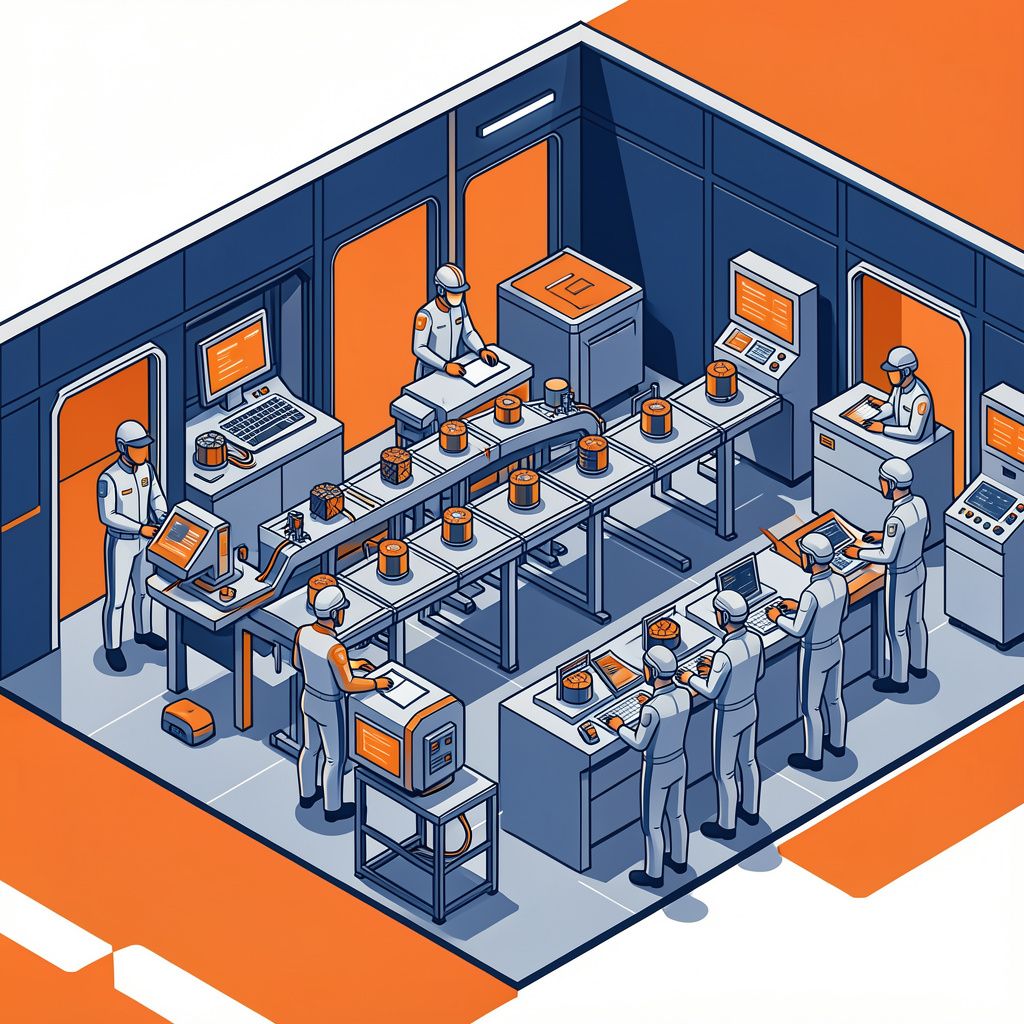
The newly inaugurated Stellar Hub in Settimo Torinese, situated on the outskirts of Turin, marks an operational shift towards serial manufacturing for orbital platforms [2][5]. Officially inaugurated in late October 2026 after work began in July 2025 and finished on 23 October 2026 [2][5], the plant was delivered following approximately 15 months of facility renovation backed by an entirely private investment of more than €20 million from Comat [2][5]. Comat, an industrial group steered by the Micelli family, established Space Industries S.p.A. in Turin in 2025 alongside Italian-American aerospace executive Giuseppe Santangelo [1][2][5]. By adapting repetitive, automotive-style assembly-line logic to aerospace engineering, the complex tackles persistent bottlenecks in European aerospace supply chains, where bespoke, artisanal fabrication has frequently constrained delivery cadences for high-tech systems and materials (HTSM) [5][GPT].
Industrial Scale and Integrated Qualification Infrastructure
Spanning an overall footprint of roughly 8,000 square metres, Stellar Hub incorporates approximately 2,000 square metres of ISO 8 certified cleanrooms, establishing it among the largest cleanroom facilities in Europe [2][5]. The industrial plant is configured to engineer, assemble, integrate, and test small and medium spacecraft weighing up to 600 kilograms, with a theoretical maximum capacity reaching 140 satellites annually at full operational ramp-up [2][4][5]. The factory layout is architected around 12 distinct modular integration bays, of which four are currently operational [1][5]. Space Industries estimates that the baseline production cycle for an individual satellite platform spans approximately six months within these standardised bays [5].
Turnkey Environmental Testing and Strategic Dual-Use Utility
A defining structural feature of the site is the full integration of the environmental qualification regime under a single roof, avoiding the fragmented logistics that traditionally separate manufacturing from testing centres [2][5]. Stellar Hub houses a comprehensive testing suite, including three-axis vibration bays, electromagnetic compatibility testing, and thermal-vacuum chambers capable of plunging to temperatures as low as -170 °C [5]. Beyond testing services, the plant operates on a platform-agnostic co-design and industrialisation model, while leasing cleanroom space to external client engineering teams [5]. Como-based orbital logistics firm D-Orbit has emerged as the anchor customer, utilising the Settimo Torinese site to run three-axis vibration testing on its Ion orbital transfer vehicle [5]. Concurrently, the facility has validated the Layer-0 upgrade—a new silicon detector array for the AMS-02 cosmic-ray spectrometer operating on the International Space Station since 2011—engineered in partnership with CERN, INFN, NASA, MIT, and Alca Space ahead of planned astronaut installation in early 2027 [5][GPT]. This integrated capacity also underpins sovereign demand for dual-use technologies, robotics, and secure orbital communications infrastructure [GPT].
Long-Term Commercial Targets and Workforce Trajectory
Space Industries currently operates with around 40 staff members and manages three active industrial contracts [1][3][5]. To service rising commercial and institutional backlogs, management aims to scale the workforce beyond 200 personnel by 2030, representing an targeted employment increase of 400% [1][2][5]. Financially, the company has established an annual turnover target of €30 million by 2030, while Comat and executive leadership evaluate preliminary options for expanding the Settimo Torinese manufacturing footprint to accommodate higher throughput requirements across the wider European aerospace sector [1][2][5].
Sources & Ecosystem Partners
- www.euronews.com
- stream24.ilsole24ore.com
- it.euronews.com
- www.google.com
- www.google.com
- www.google.com
- www.google.com
- sg.news.yahoo.com