
Dutch Classrooms Step Back From Digital Screens to Protect Pupil Focus
The Hague, Saturday 31 October 2026
Dutch institutions are replacing laptops with pen and paper, as educators and an 88-seat parliamentary majority push to curb digital distraction and restrict generative artificial intelligence in primary education.
Institutional Shift Towards Analogue Learning
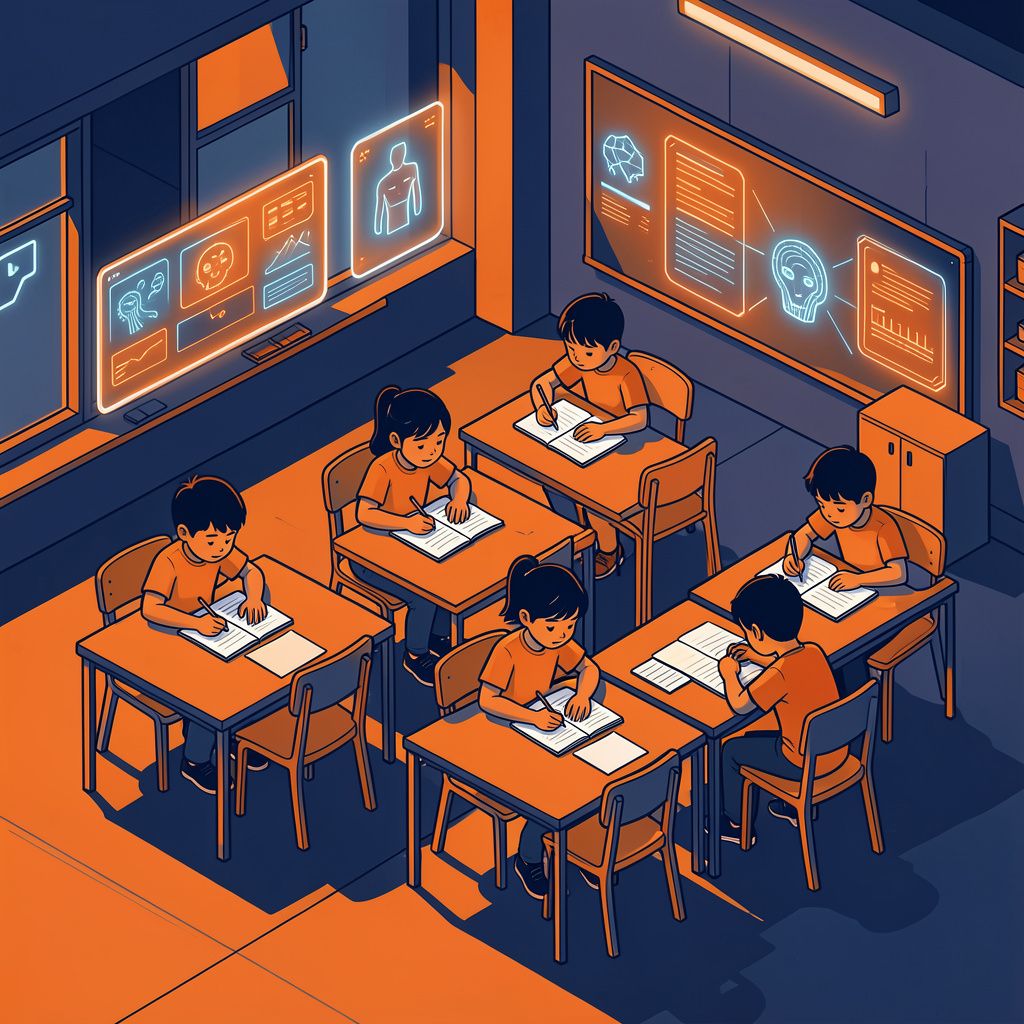
A comprehensive national inquiry by RTL Nieuws indicates that Dutch education is witnessing a broad re-evaluation of classroom digitalisation, with primary schools, vocational colleges, and universities curbing in-class laptop usage [1][3]. While earlier procurement cycles aggressively favoured educational hardware deployment, educators increasingly report that persistent screen presence undermines core learning environments [1][3]. At Koning Willem I College in Cuijk, an ongoing pilot across an ICT programme this academic year divides instruction into distinct analogue and digital spaces; during theoretical modules, students are placed in rooms where personal screens are kept out of sight, relying strictly on paper and pen [1]. Danny Thewissen from the college noted that pupils maintain sharper attention spans without digital diversions, with students actively welcoming structured separation from screen environments [1]. This institutional trial is being directly observed by the Dutch Education Inspectorate alongside the PO-Raad, the representative body for primary education [1].
Reassessing the Balance Between Hardware and Cognition
Higher education institutions across the Netherlands are executing similar measures to reduce in-lecture distractions [1]. For the current academic year, the University of Amsterdam implemented a ban on laptops and smartphones during lectures within its Interdisciplinary Social Science programme [1]. Similar restrictions have surfaced at Utrecht University, while Saxion University of Applied Sciences established a dedicated ‘high-focus’ path for first-year social work undergraduates designed to eliminate screens wherever possible [1]. Secondary institutions such as Het Amsterdams Lyceum operate predominantly with physical textbooks, paper, and pens rather than software-driven platforms [1]. Academic research highlights that handwriting prompts deliberate cognitive synthesis and summarisation of technical concepts, whereas laptop interfaces introduce multi-tasking friction [1]. However, Jessica Piotrowski, a professor of communication in the digital society at the University of Amsterdam, emphasised that reducing technology is not an automatic remedy for educational attainment, cautioning educators against viewing analogue practices as an absolute solution [1].
Parliamentary Push to Restrict Generative AI
The pushback against screen immersion coincides with heightened regulatory pressure on artificial intelligence software [4][5][7]. In late October 2026, a parliamentary majority of 58.667 per cent across ten political factions backed a legislative motion tabled by Volt and CDA calling on the government to outlaw generative AI tools, such as ChatGPT, Claude, Gemini, and Copilot, for primary school pupils [4][7][8]. Lawmakers including Laurens Dassen of Volt and Etkin Armut of the CDA cautioned against repeating past oversights surrounding uncritical social media adoption, arguing that generative automation erodes independent critical reasoning, reading comprehension, and creative synthesis [4][7]. While State Secretary Judith Tielen requested additional time to finalise a national digitalisation steering plan, the parliamentary vote sets clear constraints around commercial EdTech deployments targeted at foundational education [4][8].
Procurement Realities and EdTech Market Dynamics
The pivot towards analogue tools presents emerging structural headwinds for educational hardware vendors and Software-as-a-Service (SaaS) providers operating across the Benelux region [1][4][7]. Sector organisation PO-Raad noted that while evidence suggests high frequency use of generative AI correlates with diminishing learning efficiency, a blanket ban creates practical tensions with national curriculum benchmarks (kerndoelen) that require students to acquire responsible AI literacy [4][7]. Educationalist Barend Last cautioned that outright restrictions could compromise curriculum goals and impede constructive developments, such as specialised educational chatbots designed around pedagogical principles by textbook publishers [4][7]. While the Dutch government has allocated €10.7 million for 2027 to build a secure public AI infrastructure compliant with the EU AI Act, SaaS vendors face a recalibrated marketplace where consumer electronics are increasingly sidelined in favour of disciplined, pedagogical-first software integration [5].
Sources & Ecosystem Partners
- nltimes.nl
- www.instagram.com
- www.paboweb.nl
- nos.nl
- www.onderwijsnieuwsdienst.nl
- www.telecompaper.com
- tpo.nl
- leraar.ai