

Dutch Sleep Application Duski Launches on iOS with Privacy-First Local Audio
Ommeren, Saturday 10 October 2026
Dutch developer The IT Crowd launched its privacy-focused sleep application, Duski, on iOS in October 2026. The app generates audio locally without collecting data, featuring built-in safety volume limits for infants.
Edge Computing and Offline Audio Generation
The expansion of Duski to iOS and iPadOS on 10 October 2026 marks a notable departure from conventional digital wellness applications that rely on cloud-hosted audio streams [1]. Developed by Dutch app studio The IT Crowd, led by Ed Cafferata, the application constructs audio real-time on the end-user device rather than fetching pre-recorded media files across remote networks [1]. By shifting acoustic processing to local device hardware, the app avoids bandwidth usage and eliminates server-side hosting costs associated with traditional Software-as-a-Service (SaaS) audio delivery models [1][2].
Strict Data Privacy Architecture
Central to Duski’s operational framework is an explicit zero-data-collection policy [1]. The software functions entirely without account registration, user telemetry, or data tracking mechanisms [1]. In an era where mobile health and lifestyle tools frequently aggregate consumer usage patterns for algorithmic profiling, Duski processes all operational data strictly within the client sandbox [1][2]. This offline capability guarantees full function regardless of network connectivity, appealing directly to privacy-conscious consumer segments [1].
Customisable Acoustic Layering and Safety Features
Duski permits users to build bespoke ambient soundscapes by mixing multi-layered audio profiles [1]. The sound library encompasses white, pink, brown, grey, and blue noise; natural elements such as rain, ocean waves, wind, campfire, and streams; bodily sounds including heartbeats, uterine noise, breathing, shushing, and hairdryer simulations; alongside ambient sounds like singing bowls, fans, trains, clock ticks, airplane cabins, car rides, and arrangements by Bach, Pachelbel, Satie, and Debussy [2]. The utility features integrated sleep timers ranging from 15 to 90 minutes that attenuate volume over a final 30-second fade-out window, complemented by low-light screensavers such as counting sheep and starry night visualisations [1][2].
Age-Specific Volume Profiling and Child Safety
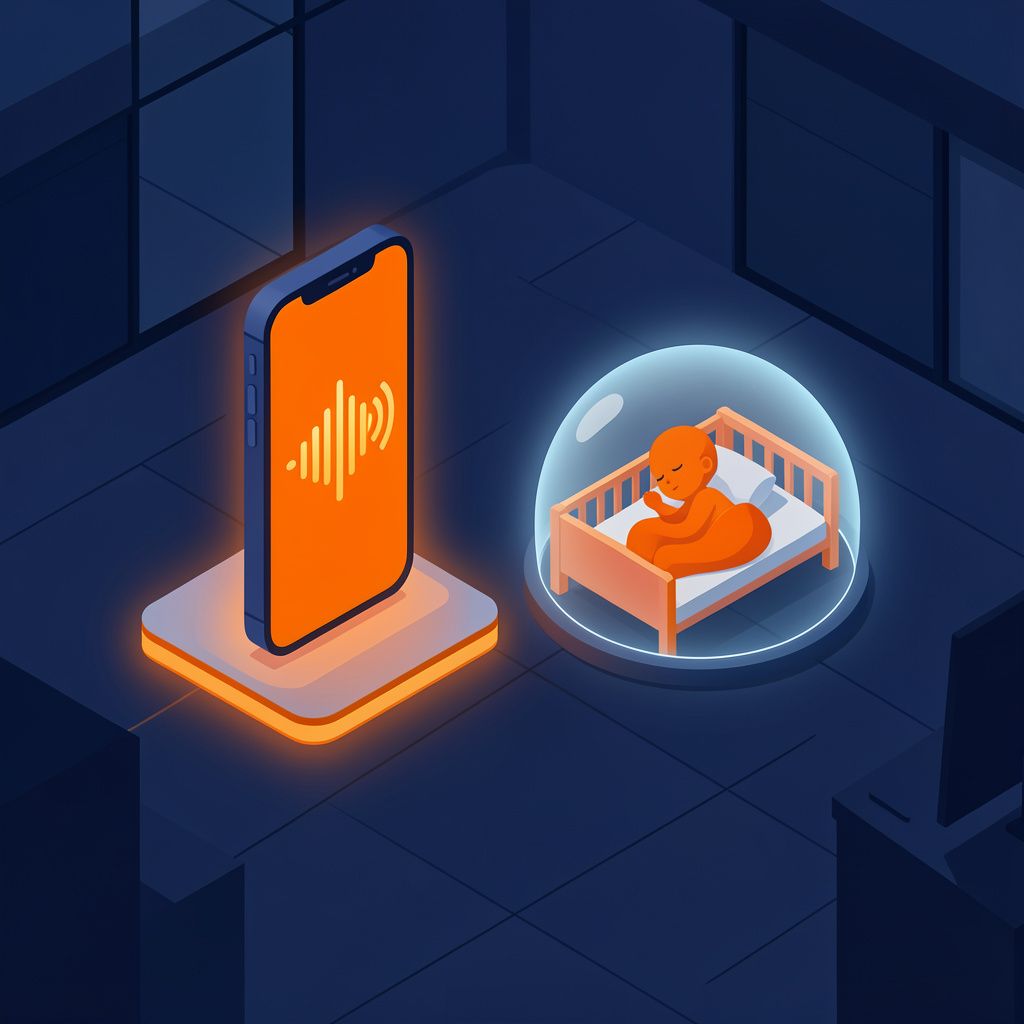
Upon initial configuration, the application prompts users to select an age category corresponding to a baby, child, teenager, adult, or elderly individual [2]. Selecting the infant setting engages a hardware-level acoustic output restriction [1][2]. Developer Ed Cafferata noted that standalone white-noise hardware frequently operates at sound pressure levels harmful to infant auditory development [1]. Duski mitigates this risk directly via software constraints rather than relying on manual consumer compliance or external instruction manuals [1].
Commercial Freemium Strategy and Scientific Transparency
The app employs a low-friction subscription model to monetise its expanded service [1]. Offered as a free download across the Apple App Store and Google Play, users receive permanent access to four basic sound layers [1][2]. The premium subscription, which unlocks all 26 sound options, operates with a 30-day complimentary trial followed by a recurring rate of €0.99 per month, cancellable at any time [1][2]. Over a full annual cycle, the total recurring fee amounts to 11.88 euros [1].
Evidence-Based Position in Consumer Wellness
Rather than leveraging sensationalised claims regarding sleep optimization, Duski explicitly aligns its positioning with research published by the American Academy of Sleep Medicine (AASM), the World Health Organization (WHO), and Harvard Medical School [1][2]. The developer actively delineates between verified acoustic soothing mechanisms and unproven pseudoscientific assertions, establishing a transparent marketing narrative that reflects a growing demand for accountability within the digital health sector [1][2].