

Dutch Food Tech Pioneer Secures Funding to Transform Cocoa Waste into Valuable Ingredients
Haarlem, Saturday 14 November 2026
Greencovery has raised €1 million to upcycle discarded cocoa shells, turning regional food-processing waste into sustainable ingredients amidst volatile global cocoa prices.
Scaling Industrial Biotechnology in North Holland
In September 2026, Dutch circular ingredients start-up Greencovery completed a €1 million financing round designed to scale its proprietary separation technology from pilot phases to an industrial manufacturing footprint [2]. The funding syndicate was led by regional development agency ROM InWest, alongside continued backing from existing shareholder Brightlands Venture Partners and individual private investors [2]. The capital injection targets the commercialisation of upcycled functional food ingredients sourced directly from side streams generated by cocoa bean processing [1][2].
Commercialising Functional Cocoa Fractions
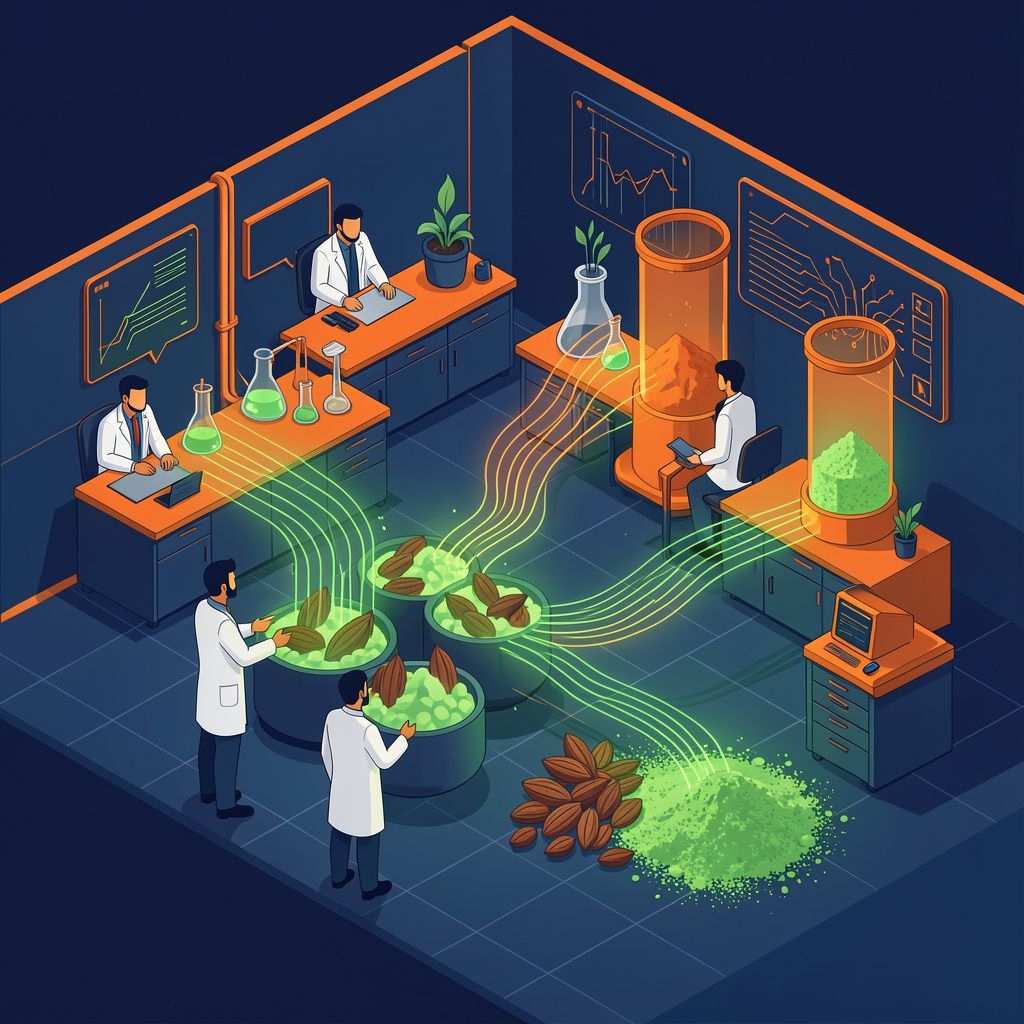
The technological core of Greencovery focuses on separating discarded cocoa shells on-site into three distinct food-grade components: hard cocoa fibres, cocoa extract, and soluble cocoa fibres [1][2]. The proprietary downstream separation system is engineered to extract dietary fibres, antioxidants, organic fats, and organic acids in a cost-effective manner [1]. By validating initial commercial test batches with corporate clients, the company aims to offer consumer packaged goods manufacturers an ingredient buffer against ongoing price fluctuations in the global cocoa market, alongside addressing consumer demand for clean-label, low-sugar formulations with natural flavouring [1][2].
Addressing Agrifood Side Streams at the Regional Source
Geographic placement within North Holland plays a critical role in the economic viability of the company’s circular supply chain [1][2]. North Holland represents a key European hub for food processing, generating more than 350,000 metric tonnes of food-safe residual side streams each year [1][2]. Historically, discarded cocoa shells across regional facilities have been incinerated or exported for low-value agricultural applications [1][2]. Greencovery’s localised extraction model eliminates these disposal overheads, converting an industrial waste-management cost into a value-added commercial revenue stream [1].
The Roadmap to Thousand-Tonne Capacity and Series Expansion
In partnership with an industrial food-processing partner based in North Holland, Greencovery is deploying the fresh capital to expand operational infrastructure toward an annual output capacity goal of 1,000 tonnes [1][2]. However, public disclosures do not specify the precise commercial commissioning date or the exact baseline timeline required to realise this 1,000-tonne target [2]. Greencovery previously validated its separation mechanics on coffee, oil press cakes, and nuts, establishing cocoa valorisation as its first full-scale commercial market entry [2].
Institutional Backing and Future Capital Horizons
Regional development agency ROM InWest underscored that financing early-stage agrifood ventures provides strategic reinforcement to local biotechnology ecosystems, particularly when partnerships ensure direct feedstock off-take with local manufacturers [1]. Parallel to this €1 million deployment, Greencovery is finalising an additional €3 million funding round, having secured preliminary commitments from both existing and incoming investors [1][2]. Combined, the two tranches represent a cumulative fundraising pipeline of €4 million to finance full commercial-scale manufacturing and bulk ingredient distribution [1][2].