

How Music Festivals Are Pioneering the Future of Clean Water
Amsterdam, Saturday 24 October 2026
Dutch music festivals are successfully proving closed-loop water treatment at scale, converting wastewater into reusable resources and offering municipal utilities a viable blueprint for long-term climate resilience.
Decibel Outdoor and ADE: Validating Closed-Loop Systems at Scale
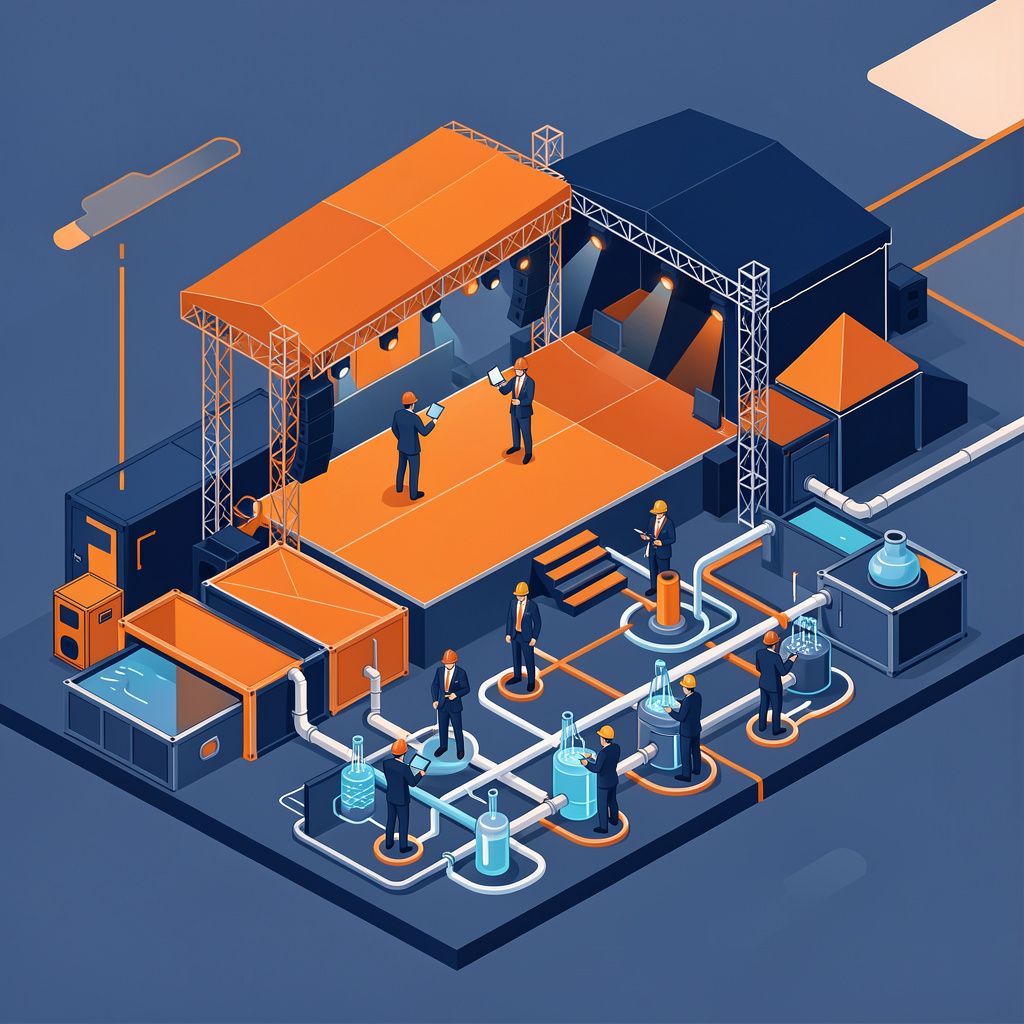
The operational stresses of temporary high-density gatherings provide a rigorous test environment for circular infrastructure [1]. At the Amsterdam Dance Event (ADE) Pro conference, held from Wednesday 21 October to Saturday 24 October 2026 at the Felix Meritis venue in Amsterdam, industry experts evaluated how festival environments function as real-time research and development facilities [1]. Maarten van ‘t Veld, Sustainability Manager at Superstruct and ID&T, detailed how the Decibel Outdoor festival was converted into an active circular living lab to trial advanced closed-loop water treatment and local resource recovery systems [1]. In dynamic event environments where tens of thousands of temporary inhabitants generate sudden peaks in wastewater volumes, robust decentralised filtration, blackwater separation, and nutrient extraction techniques must operate under strict discharge thresholds and logistical constraints [1][4].
Scaling Micro-Filtration and On-Site Nutrient Reclamation
The technical implementations reviewed during ADE’s sustainability sessions highlight how compact purification architectures can decouple intensive human activities from regional freshwater supplies [1][4]. Working alongside specialist infrastructure providers such as MTD Water, represented at the ADE Matchmaking Hub on Friday 23 October 2026 by Paul Verhoeven, circular event specialists have demonstrated rapid wastewater purification loops that recapture greywater for utility sanitation and extract nitrogen and phosphorus compounds [4]. Alongside water systems, parallel trials of bio-based materials—such as plant-based vinyl presented by Marc Carey of Evolution Music—demonstrate a unified shift towards circular supply chains across event ecosystems [4]. These high-throughput trials deliver crucial empirical performance data on membrane fouling rates, energy footprints, and chemical stability under intermittent loading regimes [GPT].
Bridging the Gap to Chemical Clusters: Chemelot and Rotterdam-Antwerp
The technical knowledge harvested from temporary decentralised plants is directly informing industrial decarbonisation across the Benelux chemical corridors [GPT]. Major industrial hubs—most notably the Chemelot complex in Geleen and the integrated petrochemical cluster stretching from the Port of Rotterdam to Antwerp—face mounting operational challenges stemming from climate-induced low river flows and stringent European discharge directives [1][GPT]. These industrial complexes consume vast volumes of demineralised process water and cooling water, requiring large-scale capital deployment into non-potable loop reclamation [GPT]. Techniques refined within festival living labs, including rapid biological polishing and closed-loop membrane bioreactors, present modular solutions to treat complex effluents before discharge into fragile river basins [1][GPT].
Industrial Chemistry, Hydrogen Integration, and Feedstock Circularity
Circular water management is an essential operational enabler for sustainable chemistry and green hydrogen infrastructure across the North Sea transition zone [GPT]. Electrolyser plants producing green hydrogen require ultrapure demineralised feedwater, consuming roughly 9 to 10 kg of demineralised water for every 1 kg of hydrogen produced [GPT]. Reclaiming secondary industrial wastewater prevents green hydrogen hubs in Rotterdam and Antwerp from cannibalising local drinking water resources [GPT]. Furthermore, recovering process streams matches broader industrial circularity principles being debated at forums such as Dutch Design Week’s Cradle to Cradle Café in Eindhoven, co-organised by tile manufacturer Mosa, where financiers and manufacturers explore the financial mechanics of material recovery [3]. Industrial chemical manufacturers are aligning these water reclamation loops with circular carbon feedstocks and catalytic processes to transition away from fossil-derived inputs [GPT].
Policy Integration and Utility Governance Across the Benelux
Scaling circular solutions from isolated living labs to national utilities demands proactive regulatory coordination and strategic leadership [1][5]. Speaking at ADE’s circular solutions panel alongside founder director of Drinkable Rivers Li An Phoa, Mare de Wit, Future Ambassador for Water and Climate Adaptation at the Dutch Ministry of Infrastructure and Water Management, emphasised that youth advocacy and progressive policy frameworks are critical to codify decentralised water recycling into planning standards [1]. Regional utility governance is simultaneously realigning to support these operational models; World Waternet announced on 22 October 2026 that Bertrand van Ee will take over as interim chief executive officer from 1 November 2026, steering municipal water technology and international partnerships [5].
International Knowledge Transfer and Investment Horizons
The methodologies established across Dutch living labs are rapidly extending into international environmental policy frameworks [2]. Dutch water expert Maartje Faasse is scheduled to present implementation models from regional pilot programmes at the Circular Water Economy Conference 2026 (CWE2026), taking place on 29 and 30 October 2026 at the University of Cyprus [2]. Supported by the Embassy of the Netherlands in Cyprus, this cross-border transfer illustrates how scalable wastewater reclamation and circular infrastructure blueprints developed across the Low Countries can assist Mediterranean climates experiencing acute drought stresses [2]. For infrastructure investors and municipal utility planners, the transition of closed-loop systems from music festivals to industrial chemical clusters demonstrates that water circularity offers both operational de-risking and quantifiable asset resilience [1][2][GPT].