

How Flexible Robots Are Solving European Warehouse Labour Shortages
Paris, Wednesday 28 October 2026
Station F standout Marso Robotics prepares its first live deployment, offering modular robots that integrate into existing logistics facilities without requiring costly infrastructure retrofits.
Retrofit-Free Physical AI Reaches the Warehouse Floor
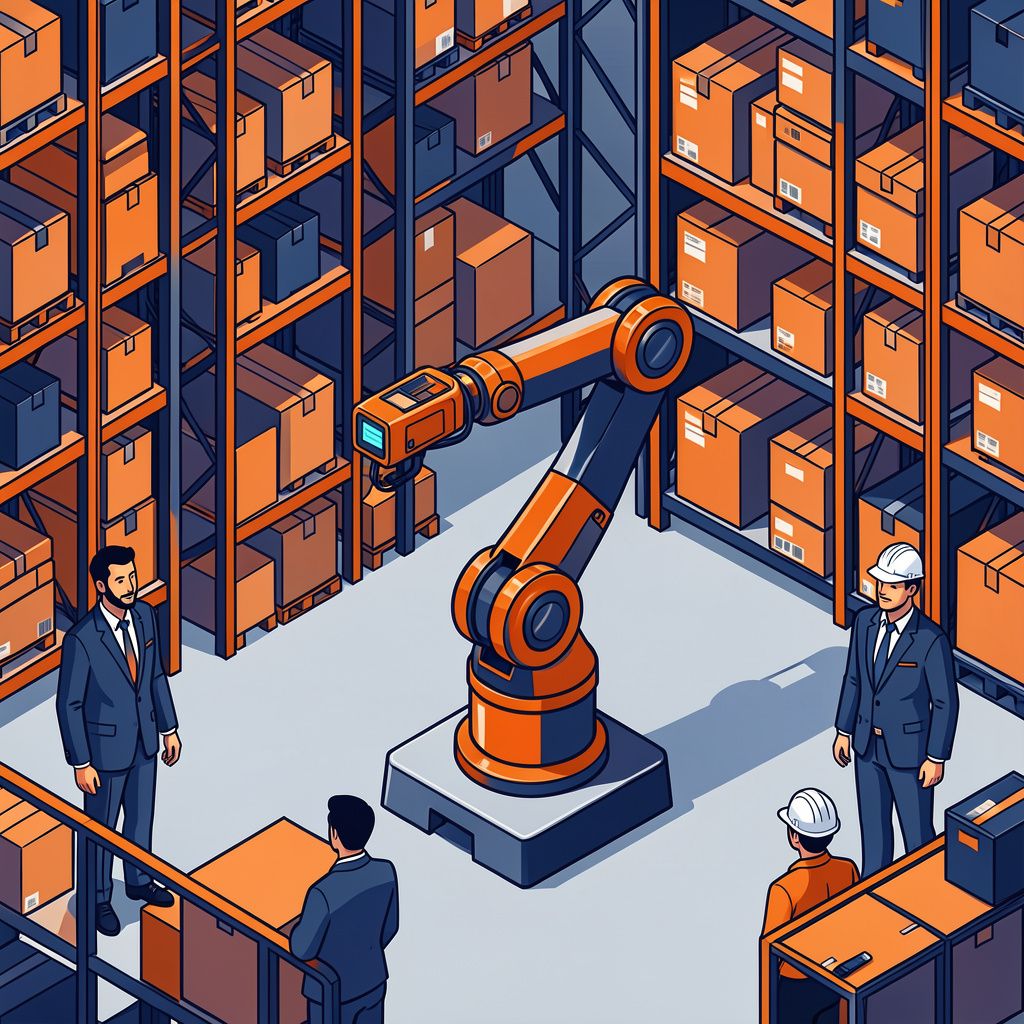
On 27 October 2026, Paris-based startup campus Station F announced that Marso Robotics, an alumnus of its Future 40 2025 cohort, is preparing to launch its first commercial physical artificial intelligence system live at an enterprise customer site [1][2][3]. Co-founded by Louis Caudrelier, Nicolas Texier, and Thibault Moraisin, the venture has expanded its engineering and operations headcount to 30 people within a single year of entering the index [1][2]. The company designs autonomous mobile manipulation platforms embedded with physical AI, specifically engineered to integrate directly into active warehouse topologies without mandating structural modifications or costly retrofits [1][2]. By automating physically demanding, highly repetitive freight-handling tasks, the system provides immediate operational capacity to high-throughput distribution environments [1][2].
Strategic Tailwinds across Benelux Freight Hubs
The deployment comes at a pivotal juncture for supply chain corridors spanning Venlo, Rotterdam, and Antwerp, where logistics providers face severe structural labour bottlenecks alongside rising operational costs [GPT]. Traditional automated storage and retrieval systems demand capital expenditures running into tens of millions of euros, lengthy commissioning schedules, and extensive facility downtime [GPT]. In contrast, software-driven mobile robotics operating on physical AI paradigms allow third-party logistics providers to implement non-invasive automation with rapid return on investment [GPT]. For venture capital syndicates across Continental Europe, this capital-efficient model unlocks scalable automation inside legacy warehouse assets that were previously deemed unsuitable for fixed robotic gantries [GPT].
Dual-Use Potential and High-Tech Resilience
Beyond civilian freight logistics, the fundamental technologies underpinning adaptive physical AI—including low-latency real-time spatial awareness, edge inference, and robust manipulation hardware—intersect directly with high-tech systems and materials (HTSM) and European strategic resilience priorities [GPT]. The capacity of autonomous systems to navigate unstructured industrial terrains, handle variable payloads, and perform unassisted material handling mirrors requirements across modern dual-use supply chains, including defence equipment maintenance, military depots, and critical energy transition manufacturing [GPT]. As European industrial policy increasingly prioritises sovereign technological capabilities, modular robotics platforms operating directly on legacy shop floors represent foundational infrastructure for national economic security [GPT].
Sources & Ecosystem Partners
- www.linkedin.com
- x.com
- www.facebook.com
- www.instagram.com
- www.welcometothejungle.com
- www.welcometothejungle.com
- www.welcometothejungle.com
- www.welcometothejungle.com